


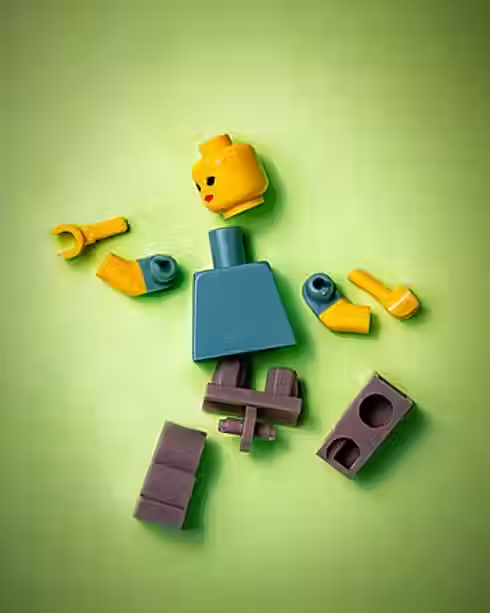
Estrangement &
Family Dynamics
Life doesn’t always go as we plan or hope.
Children don’t always feel they received the parent they needed, just as parents don’t always feel they received the child they expected. And yet—despite this mismatch- love between parent and child is often deep, instinctive, and enduring.
The human bond between parent and child is one of the most powerful connections we experience. But life happens. Sometimes things go wrong in ways neither side fully intended, and despite best efforts, some adult children make the painful decision to go “no contact” with a parent- or, in some cases, with both parents.
When this happens, it can feel like the ground beneath identity itself shifts. For many parents, it is not just a loss of relationship, but a loss of meaning, role, and emotional continuity.
This space exists to explore that experience honestly.
This is not a place for blame or simplification. It is a structured way of understanding something that is often experienced as chaotic, confusing, and deeply painful.
This is how I learned, and how I began to heal.
If you find something in these pages that helps you make sense of your own experience, then it has served its purpose.
My hope is that as more people begin to speak about estrangement openly and without shame, the stigma surrounding it will soften- and the silence that surrounds it will begin to break.
Because what so many people are living through is not rare, and not invisible, even if it often feels that way.
It is part of a much larger, deeply human pattern of connection, rupture, and rebuilding.
The deeply troubling epidemic the world is grappling with

This hub explores parental estrangement from multiple perspectives, including psychology, family systems, trauma, attachment, identity, recovery, reconciliation, communication, boundaries, and meaning-making.
When Lewis Carroll’s Alice headed off to Wonderland, she found many rabbit holes on her journey, some more enlightening than others. But when she finally found her way home, she realized that she had the answer all along. It was within.
And it matters that you find the answers, find the path out of the fog, the grappling with your identity, the debilitating effects of parental estrangement. We hope our article shine a light on your path.
BUT: Please, if you need help or find yourself in a crisis, seek out help. People can be awful, but I've found that people can also be beautiful- and it was the people who walked alongside me through my journey who helped me find my way. Not everyone is a critic or a troll.
Estrangement
What is it?
-
Deconstructing Parental Estrangement describes the breakdown of a once-existing, deep family connection between parent and adult child.
-
For most adult children, it's the result of a series of events, some traumatic, that lead to a breakdown of effective communication leaving cutting off as the only option that feels right in that moment.
-
For most parents, it's also not a single event, but as a prolonged state of confusion, grief, and identity disruption.
-
This is a structured map of the forces, experiences, and rebuilding pathways involved.
Mechanics of Estrangement
How did this happen to me?
The interacting psychological, relational, and external forces that shape estrangement.
-
Parents' identify investment in their child: The child's role in the family- e.g. where does a rainbow babies born after a miscarriage fit in, core family values, and generational differences.
-
Emotional history / attachment patterns- are there emotional gold diggers within the family?
-
Understanding children’s rights, expectations, and responsibilities
-
The broader human picture
Parent-child dynamics
External Influences
-
Has Therapy For Parental Estrangement Contributed to its Surge?
-
Control of access and communication channels: The role of an adult child's new relationships
Autonomy of the Adult Child
-
Emotional regulation capacity- self-awareness
-
Cutting A Narcissistic Parent Out Your Life- an adult child's autonomous decision
The Estrangement Experience
Who am I now that the old structure is gone?
The internal collapse of identity, meaning, and relational continuity
-
Stripping away your identity as a parent: Dehumanizing A Human Family Member
-
Heaven, Hell, or Purgatory? Difficulty setting boundaries and barriers
-
Living in Heaven, Hell, or Purgatory?
Identity disruption
Emotional confusion and looping cognition
Grief without closure
-
A parent as well as the adult children feel isolated, lost, and live in a fog.
Trauma does not change who you are
-it removes what was never you.
Rebuilding After Estrangement
What Comes Next?
The process of identity reconstruction and meaning integration after relational rupture.
Identity Reconstruction
-
Rebuilding Your Life: How To Build A New Life After Trauma Takes The Old One
-
Boundary formation and emotional clarity
-
Find Ways To Heal From Estrangement As A Parent
-
Learn how Self-Awareness Picks You Up When People Break You Down
-
Understanding Human Connection: The Alpha And Omega Of The Human Condition, using a new perspective.
-
Consider whether Suffering is Just Part Of The Human Condition
Meaning Making After Loss
Emotional regulation and grounding practices
-
Consider alternative healing paths: We discuss one in, “Healing Makes Our Hearts Happy”: Do The San People Have The Sane Path To Ancient Healing?
-
Question whether Self-Sabotage Fuels Fear Of Success


FAQ: Parental Estrangement Frequently Asked Questions
Q: What does estrangement mean in a family context?
A: Family estrangement is the physical and emotional distancing between at least two family members, usually as a result of a long history of a negative relationship or significant conflicts, although it often happens that the person who leaves holds grudges anger that are unseen, and not discussed, for various reasons. One or more person intentionally reduces or cuts off contact, generally for what they see as their well-being.
For a more detailed description of parental estrangement, read Deconstructing Parental Estrangement: The Helter-Skelter Trend That Deconstructs Lives
Q: What are the key characteristics of estrangement?
A: Emotional and physical distancing, usually with a complete cessation of all communication and physical presence (known as "no contact"). It is an intentional, voluntary, and conscious choice made by a family members to protect their safety and emotional or mental health from a harmful situation. One person usually initiates the break, while the other might be "blindsided." Estrangement can be temporary or permanent.
Some of the key characteristics are:
-
The difficulties in breaking the remaining emotional link- see Mothers' & Adult Children In Parental Estrangement Entanglements: You Can Check Out Any Time You Like, But You Can Never Leave
Q: What are common causes of parental estrangement?
A:
-
Abuse (physical, emotional, or sexual), neglect or betrayal
-
Traumatic family events, including divorce or separation
-
Mental health problems,
-
Substance abuse by either the parent or the child
-
Clashing values or expectations.
-
Lack of support, financial or emotional
-
Poor communication leaving unresolved issues
-
Influence of others, particularly a partner of the adult child, who may be tempted to exploit existing tensions to their own advantage.
-
Unhealthy therapy that teaches division rather than problem-solving, emotional intelligence, conflict resolution or interpersonal skills.
Suggested reading: Deconstructing Parental Estrangement: The Helter-Skelter Trend That Deconstructs Lives
Q: What role do adult children’s spouses play in parental estrangement?
A: Adult children's spouses often play a significant role in parental estrangement, whether it be as the source of conflict or to act as a supportive third party. Clashing values and conflicting loyalty demands within the extended family system are often key as the he adult child may feel pressure to balance loyalties between their partner and their family of origin.
From the adult child’s perspective, the spouse is their partner in their primary family unit, and loyalty to the partner is crucial for the marriage's health. Where compromises cannot be reached, estranged parents would be well advised to examine whether their adult child's spouse is a convenient external factor to blame, and look at their own potential role in the estrangement. It’s often a case of “it takes two to tango.”
But it also takes two to tango together to define new boundaries and expectations. Assigning blame is seldom a productive strategy.
Suggested reading: Kinkeeper Reapers: The Heartbroken Houses Of Svengali Spouses
Q: Is parental estrangement always permanent?
A: No, parental estrangement can be permanent or temporary.
Q: How long do adult children usually go no contact with parents?
A: The length of estrangement is different for every family and can depend on individual circumstances and efforts to reconcile. Adult children going no contact with their parents usually stay no contact for about nine years on average, over seven years with with fathers and over five years with mothers.
It’s key to reconciliation to keep in mind that both the adult child and the parent may no longer be quite the same as when the estrangement started. Hopefully, both have learned new life and emotional intelligence, but the parent is especially at risk during reconciliation, having likely spent years frozen in grief and confusion before finding healthy ways to communicate and resolve conflict effectively.
Suggested reading: Ways To Heal From Estrangement As A Parent
Q: How can a parent cope with the emotional pain of estrangement?
A: When a child goes no-contact, a parent experiences grief in much the same way as a parent who lost a child who passed away, except that an estranged parent’s child is still very much alive, but not to them. This adds additional layers of confusion, including confusion over why it happened, self-doubt, and the harsh but unfair judgement of society. To heal from parental estrangement takes a significant amount of time and effort, but some ways to consider are:
-
Own that you want to heal, you want a better life.
-
Embrace the thought that you deserve a better life.
-
Get educated on the subject of parental estrangement.
-
Accept support from those around you and, if necessary, specialist therapists with good references.
-
Look after your physical health.
-
Find and own your new identity. Saying “I am an estranged parent” is exceptionally difficult, but can also be liberating and could be the start to forging a new, better identity.
-
Practice daily rituals like journalling, gratitude, prayer, or anything else that brings you peace.
Here’s a good place to start: Ways To Heal From Estrangement As A Parent
Q: How Do I Heal From Parental Estrangement As A Parent?
A: Parental estrangement, which has sadly become a trend, is one of the most devastating phenomena that robs the joy, the identity, the life from a parent, leaving them reeling in pain and confusion, with a whole lot of society inflicted guilt to boot.
But eventually, after a long time- often years, the pain blended with the daily numbness of nothingness, drives us to seek healing. Healing can be found, and often, by taking the healing path, we discover meaning too, and there are beautiful moments ahead for those who can muster the courage to heal.
Find some thoughts about ways to heal from estrangement and decide what would work for you.
Q: What are a child's rights against their parents?
A: Every single child deserves to be treated with dignity. It's their absolute human right. But as a human who enjoys rights, some responsibilities limit these rights, although these duties only emerge as they age. A child's rights against their parents, include:
-
To be protected from harm, including maltreatment, neglect, abuse, and exploitation.
-
To have access to basic necessities like nutrition, shelter, healthcare, and education.
-
To be given a name and nationality.
-
To have their best interests considered in all decisions affecting them.
-
To grow up in a safe environment.
Some argue that children also have the right to participate in decisions that affect their lives, but this is also limited by their limited ability to make well-thought-out decisions as children.
Find out more in this article: Children’s Rights & Expectations vs The Corresponding Children’s Responsibilities
Q: Can other people influence a child to leave their parents?
A: There are many example of children- even adult children, cutting off their parents and going no no cact, leaving the parent confused, dazed, and in a state of grief. These include:
Q: Has Psychotherapy Contributed to the Surge In Parental Estrangement?
A: As self-help celebrities, for example Oprah, found platforms to engage vast audiences in the 1980s and 90s, a new type of therapy emerged that urged people to cut off the people who the perceived as harmful, rather than examine and heal the underlying causes.
Life coaching then soon became a career choice with an easy entry: there are no real academic requirements or controlling authorities to lay down professional standards. But the epidemic of parental estrangement that surged out of the self-help type of media meant there were many prospective customers and lots of money to be made.
To a large degree, verbal communication and interaction —the cornerstone of psychotherapy has been rejected in favor of paid therapy sessions. There are many reputable therapist globally who conduct their business in an ethical, sometimes empathetic way, but unfortunately, the numbers of "therapists" who guide their customers and followers (who they don't even view in the clinical sense as patients) have contributed to to surge in estrangement- and are now offering new, paid solutions.
We delve deeper in the article "Has Psychotherapy Contributed to the Surge In Parental Estrangement?"
Q: Do estranged children lose connection with their parent forever?
A: A mother is ground zero for every person’s life. This foundation is inescapable. If nothing else, she was there the moment you were born. Every human life, with its unique collection of fragments that make up the whole, has two things: value and potential. Leveraging that value and potential, connecting to other humans is inevitable.
From the family, people join others in school and learn shared lessons, sometimes in the classroom, sometimes in the playground and develop as the child grows, physically, mentally, and spiritually and starts to learn what being human means.
Usually, the family supports and guides the child through their growth that typically transitions from a family-guided and monitored path to a trial-and-error system, which we begin to implement while still seeing ourselves as all-seeing, all-knowing teenagers. This shift occurs as family bonds start to loosen or are torn apart, sometimes leading to parental estrangement.
But, connected through many generations, these connections remain meaningful through the shared life on Earth, the soul and DNA connection ,and remain key to our happiness, learning, and life.
Suggested reading: The Human Connection: The Alpha And Omega Of The Human Condition
Q: Does estrangement dehumanize a parent?
A: Once limited to being an essential weapon for narcissists and psychopaths, dehumanization has seeped into many facets of life, as people struggle to survive and strive to thrive. The so-called personal growth through the generations, and the parental estrangement trend has seen parents being unfairly accused of abuse, of being narcissists, and other abusive terms for simply parenting, that sometimes includes a little tough love, and often times is something the parent does under extremely difficult circumstances, but always with love and the best interests of their child at heart.
Dehumanization- the ruthless, extraordinarily cruel psychological process of demonizing the enemy, effected on a human by another human, making them seem is designed to make the victim appear less than human and therefore not worthy of humane treatment. It is an intentional act, a weapon deployed by those with little understanding of, or regard for, what it means to be human.
Yet parents are being dehumanized by the people they puit their hearts and souls into, and built an identity around. But, in the confusion, parents are often left feeling less human, their identities taken away overnight.
To heal, it's key to understand what really happened.
Find out about how The Unfathomably Inhuman Act Of Dehumanizing A Human Family Member affects parents.
Q: Should I cut a narcissistic parent out of my life?
A: Cutting a narcissistic parent out your life is a difficultm life-changing decision, made all the more difficult if your parent truly is a narcissist- not just because you don't agree on many things. It's also highly personal- all family relationships are different, and you are best placed to understand the dynamics of yours. Important things to consider:
-
Is your family member abusive? If they are, your immediate personal safety is paramount
-
Is there any way you can sit down and have a conversation with the family member and try to create some rules going forward?
-
Would it be better to enforce some boundaries before making such a hard decision?
-
Going no contact with a parent will change both lives forever and may have both positive and negative consequences for both people that should be understood before the decision is made.
-
Educate yourself on what parental estrangement entails.
-
Going no contact just because you're angry is never a good idea.
-
Think things through, especially the consequences before making the final decision.
Recommended reading: Cutting A Narcissistic Parent Out Your Life
Q: Why do my children emotionally abuse me?
A:Kids go through phases, including the "I hate my parent" phase, and sometimes take a long time to grow up and take responsibility for themselves.
But sometimes parents, laden with responsibilities and to do lists, inadvertently make themselves the family punchbag. And that's not healthy for anyone.
If it feels like you magnetically attract people to keep on landing blows on you, even your kids, you may want to consider some boundaries.
Read about Demagnetizing Your Emotional Punchbag Allure
Q: Is healing from estrangement the same as trauma recovery?
A: Estrangement is exceptionally traumatic, often life-changing event for the person who was cut off. The symtoms experienced often include the same symptoms as other PTSD sufferers, like war veterans, natural disaster survivors, and abuse victims.
It can be beneficial to identify Signs And Symptoms Of Post Traumatic Stress Disorder (PTSD), as an understanding of your current state is more easily addressed if you understand what the underlying issues are, and can start rebuilding your life after kids go no contact.
There are some differences between the ways estranged parent recovers from trauma, but many of the PTSD healing modalities are equally applicable to estranged parents.
To start recover, you may want to look at How To Build A New Life After Trauma Takes The Old One.
Q: What is an emotional gold digger?
A: Some people, especially men, leave the emotional heavy lifting to their partners. Or, as the term emotional gold-digger implies, rely on women for their own emotional needs.They mine the emotional support they struggle to find within themselves.
While emotional gold diggers see their trusted partners as the goldfields of emotions to be mined in their quest for emotional enrichment, often, this has negative consequences. For example, manipulative partners like kinkeepers are sometimes seeking to extract benefit from the relationship and would see the digging as a vulnerability to be exploited, with disastrous consequences to the entire family.
Find out more at: Emotional Gold Diggers: Lion-hearts Who Dig Anywhere But Within For Emotions
Q: Can other people influence a child to leave their parents?
A: Yes, often people turn to others for advice, and sometimes those opthers don't fully understand the whole picture. People look to friends, therapists, and even celebrities for advice, and follow that advice without properly considering the consequences.
We live in an age of influencers, where people can influence vast numbers of followers, but it's often those closest to us that have the most influences.
See how a partner can influence someone: Kinkeeper Reapers: The Heartbroken Houses Of Svengali Spouses
Q: What role does hope play in healing from estrangement?
A: Sometimes, you have to hope just to cope. But hope goes far deeper than that too. Hope is a longing, a wish, a yearning, tempered by expectation and absolute trust. And it’s an indispensable part of being human .
But hope is about the future, not the past. It reminds us not to dwell on what's behind, but on what lies ahead. The meaning of hope is life itself, and the living of it. This is especially important for estranged parents who are rebuilding their lives and rediscovering their identities.
The optimism associated with hope helps you leave the past in the past and look to the future with a certain confidence or hopefulness for the future, for something's success.
We've delved into The Meaning Of Hope: Humanity, Dreams, and Destiny here.
Q: Why did my child reject me?
A: Every family is different and every child within the family is different. Each person has personal reasons for rejecting a parent- it's not just because of their circumstances, but it's how they perceive those circumstances, how they make sense of their lived experience.
This is one real-life story from a mother whose child cut them off: Why My Children Rejected Me
Q: What does Oprah say about estrangement?
A: On parental estrangement, Oprah Winfrey is almost right about one thing when she recently said, "Some experts believe that there's been a shift in how younger generations protect their mental health and their boundaries, or have an expanded view of what is considered abuse. And that has led to a silent epidemic."
Oprah recently returned to the controversial subject of estrangement, yet many people think Oprah caused estrangement. She held sway over millions of people for many years (accumulating vast wealth in the process) and encouraged people to go no contact with their parents, creating a problem she appears to be now offering a new, potentially lucrative platform for.
We asked the question: Oprah On Parental Estrangement: Is She Capitalizing On The Problem She Created?
Q: How do you set boundaries with an estranged family member?
A: Demarcating the line marking the limits of an area, boundaries also demarcate the limits of human interaction.Trust is the crucial factor when it comes to deciding who to let into one of our comfort zones. Higher levels of trust make us feel more comfortable when people cross boundaries, including family members.
Weak boundaries are rooted in several causes. A history of abuse- whether it's emotional psychological, physical, or sexual, parent-child conflict, domestic violence, and trauma. Trauma affects us deeper than we could possibly have imagined in our worst nightmares.
Boundaries with family members should be defined and communicated. They are the barriers to healthy interaction and connection with other humans can be broken down with confidence in yourself, and by having the courage to be yourself- and allowing yourself some self-love and respect.
We explored: Boundaries, Barriers, And Minding Your Own Business (The MYOB Rule)
Q: How would you describe how it feels like to be an estranged parent?
A: In Deconstructing Parental Estrangement: The Helter-Skelter Trend That Deconstructs Lives, we compare parental estrangement with the Helter Skelter scenario (an apocalyptic vision reportedly associated with serial killer and cult leader Charles Manson and members of his “family,” culminating in brutal murders and ruined lives). It has that chaotic, hopeless feel.
In a very different context, parental estrangement can feel like a psychological version of the same phrase: not physical destruction, but internal fragmentation. The body remains intact, but something essential feels lost- sometimes to the point of emotional disintegration.
Over time, many estranged parents find themselves moving through confusion, grief, and meaninglessness, until they begin the slow process of rebuilding- not necessarily the old family structure, but a new internal reality that can still hold meaning.
Q: What is parental estrangement?
Parental estrangement occurs when an adult child makes the decision to cut off contact with a parent.
This may be temporary distance, space-taking, or emotional separation. But when it becomes a deliberate, sustained choice to end the relationship entirely, it becomes estrangement.
The consequences are significant for both parent and child, often reshaping identity, emotional stability, and family systems on both sides.
Deconstructing Parental Estrangement: The Helter-Skelter Trend That Deconstructs Lives explains in detail.
Q: Why is so much parental estrangement happening now?
A: Familial estrangement is no longer rare. Research and reporting suggest it is increasingly common:
• A 2023 ScienceDirect study estimates that a large proportion of people experience estrangement at some point in their lives
• APA-related findings suggest a significant percentage of adults report current estrangement from at least one family member
• Surveys consistently show that family cutoff is now a familiar feature of modern relationships
We deconstructed parental estrangement and looked at why it's happening- and why now, and at scale?
Q: Is estrangement a new trend?
A: Estrangement is not new.
Across human history, families and clans have fractured under pressure-through migration, survival conflict, inheritance disputes, political power struggles, and shifting social structures.
From early human dispersal, to empires built on lineage, to modern identity-based individualism, family cohesion has always been under tension.
What has changed is not the existence of estrangement- but its visibility, speed, and amplification in modern systems.
Q: Is estrangement a generational shift?
Our article about generational shifts notes that at the beginning of the last century, identity was often rooted in collective belonging: family, class, nation, or shared survival structures.
Over time, this has shifted toward individual identity formation- where personal meaning, autonomy, and self-definition often take precedence over inherited family roles. In this transition, the balance between “us” and “me” has changed dramatically.
And in that shift, family systems often become unstable before they adapt.
Q: Why do adult children go no contact with their parents?
A: There is no single cause of estrangement. It is usually a convergence of factors, such as:
• unresolved conflict
• identity formation and separation from childhood roles
• trauma that was never processed or repaired
• shame, avoidance, or emotional overwhelm
• influence from external narratives or relationships
• patterns of addiction or instability within the family system
Sometimes it's a rash decision made in the moment. In many cases, it is not one moment- but a long accumulation of meaning that eventually crystallises into a decision, although they are sometimes heavily influenced by others.
We decontructed the estrangement phenomena to find out what's behind it.
Q: Is parental estrangement the same as going no contact?
A: Not exactly.
“No contact” can sometimes be temporary, protective, or boundary-based. Parental estrangement usually refers to a more fixed or sustained breakdown where communication stops entirely and reconciliation is not currently active.
The difference is often time, intent, and emotional closure (or lack of it).
Related article: Ways To Heal From Estrangement As A Parent
Q: Why does parental estrangement happen?
A: There is rarely a single cause. Estrangement usually develops from a combination of factors such as:
• unresolved family conflict
• identity separation during adulthood
• emotional injury or perceived harm
• communication breakdown over time
• external relational influence
• differences in values or expectations
In most cases, it is not one event, but an accumulation that eventually becomes irreversible in the moment of decision.
Related article: Deconstructing Parental Estrangement: The Helter-Skelter Trend That Deconstructs Lives
Q: Why does estrangement feel so confusing and destabilising for parents?
A: Because it removes both relationship and explanation.
Most parents are not only processing loss- they are also trying to reconstruct meaning in real time without shared narrative. This creates looping thought patterns, emotional instability, and a constant search for “what happened.”
We described as estrangment as psychological “helter skelter” in Deconstructing Parental Estrangement: The Helter-Skelter Trend That Deconstructs Lives,illustrating the cycles of collapse, interpretation, and emotional reset.
Q: Is parental estrangement becoming more common?
A: Many researchers and surveys suggest that family estrangement has increased or become more visible in modern society. This is often linked to:
• shifting cultural values around individuality
• increased focus on personal boundaries
• generational differences in communication norms
• social media amplification of relational narratives
• changing family structures
Whether it is a true increase or just increased visibility remains debated- but its impact is widely recognised.
Related article: Deconstructing Parental Estrangement: The Helter-Skelter Trend That Deconstructs Lives
Q: Do both parents and children contribute to estrangement?
A: In most real-world cases, yes- although not always equally or in the same way.
Estrangement tends to emerge from relational systems rather than single actions. Both sides bring history, perception, emotional responses, and coping strategies that interact over time. This is why estrangement is rarely reducible to a single cause or person.
Related article: Deconstructing Parental Estrangement: The Helter-Skelter Trend That Deconstructs Lives
Q: Can parental estrangement be healed or reversed?
A: Sometimes, yes- but not always, and not predictably.
Reconnection depends on timing, emotional readiness, willingness on both sides, and whether the underlying issues can be revisited safely. Healing does not always mean reunion. Sometimes it means rebuilding stability, identity, and meaning even without reconnection.
Related article: Ways To Heal From Estrangement As A Parent
Q: What does healing from estrangement actually look like?
A: Healing is not a return to the past. It is a shift into a new internal structure where life becomes meaningful again, even if the relationship remains unresolved. It often includes:
• emotional regulation and grounding
• rebuilding identity outside the parental role
• grief processing without closure
• creating new supportive relationships
• accepting uncertainty without collapse
Healing is less about “fixing the relationship” and more about each person restoring psychological wholeness within themselves to bring their best selves to the relationship.
Related article: Ways To Heal From Estrangement As A Parent
Q: Why is hope both helpful and harmful in estrangement?
A: Hope can be stabilising when it motivates patience and openness. But it can become destabilising when it becomes the only psychological anchor — especially if it prevents emotional adaptation to current reality.
In estrangement, many parents oscillate between hope for reconnection and the need to rebuild their own lives in the present.
Related article: The Meaning Of Hope: Humanity, Dreams, and Destiny
Q: What is the first step in healing as an estranged parent?
A: The first step is not action- it is acknowledgement.
Acknowledging:
• what has happened
• what cannot currently be controlled
• and where your own life begins again independent of the outcome
From there, healing becomes less about fixing the rupture and more about rebuilding internal stability.
Related article: Ways To Heal From Estrangement As A Parent
Q: Does healing mean giving up on reconnection?
A: Not necessarily.
It means separating emotional survival from outcome certainty. Some parents reconnect. Some do not. Healing is what allows life to continue meaningfully in either case.
Related article: Ways To Heal From Estrangement As A Parent