


The Legal Profession: Discipline, Public Confidence, and the LPC (The Penultimate Episode)

Updated: Jul 14
From the series-
Discipline is the invisible engineering that sustains public trust in the legal profession. When disciplinary systems fail, trust doesn't collapse suddenly- it erodes quietly through delay, inaction, and procedural fatigue. Elusive access to justice follows.
A lack of firm discipline breeds a culture of impunity. When bad conduct faces no swift consequence, it multiplies.
This article examines that erosion within South Africa’s legal regulatory framework, situating the Legal Practice Council (LPC) not as a standalone institution, but as one node in a wider justice pipeline in which failure is transmitted rather than contained.
The LPC as a Legal Regulator: Part of an Ecosystem
The volume of complaints skyrockets, and an already struggling Legal Practice Council (LPC) gets buried under a mountain of files it lacks the capacity to handle. The complainants- the public, whose interests the LPC is mandated to safeguard- pay the price as the rule of law is perverted, subverted by the very professionals tasked with upholding it.
This loop raises an uncomfortable question: should the LPC simply be dissolved?
The answer isn’t simple. Total deregulation or institutional anarchy is not a viable option for an industry that serves as the administrative bedrock of justice. If the legal machinery collapses, the societal fallout is immediate. Instead of total demolition, the focus must turn to where the system is failing to adjust and who is left to hold the line.
Because the LPC does not operate in isolation. It forms one stage in a much larger justice pipeline stretching from legal practitioners and complainants through regulators, the Ombud and ultimately the courts. Pressure that cannot be absorbed at one point inevitably shifts downstream. Understanding that pipeline explains why failures inside the regulator eventually become failures experienced throughout the justice system. A systemic injustice issue.
The Judiciary as the Final Bulwark
Retired Deputy Judge President Roland Sutherland previously noted that the LPC desperately needs to catch up, identifying a growing willingness among judges to step in where professional regulators falter. The judiciary increasingly finds itself forced to put its foot down against systemic litigation abuse, unethical stalling tactics, and other ignominious conduct.
To understand the pressure on this bulwark, the math is revealing. The permanent judicial establishment in South Africa comprises about 250 to 300 judges across the superior courts (including the High Courts, the Supreme Court of Appeal, and the Constitutional Court). Meanwhile, data from the Democratic Governance and Rights Unit (DGRU) places the total number of magistrates at just over 2,000- precisely 2,036 in recent comprehensive establishment audits.
An estimated 65 million people live in South Africa. The overwhelming majority of these citizens are dealing with everyday survival litigation- like battling for basic child or spousal maintenance, dealing with local criminal prosecutions (and the effects of justice delayed by both victims and the accused), enduring domestic conflicts, or navigating labor disputes. These 2,000 lower-court magistrates are handling the entire weight of everyday societal friction.
While superior court judges deal with weightier cases that have sweeping, precedent-setting authority, those high-level rulings are no more or less critical to a functioning society than the routine matters decided in regional courtrooms every morning. What matters most is the support structure: the court administration and the legal practitioners.
When an inefficient, slow-moving LPC gatekeeper fails to police those practitioners, it isn't just a minor administrative annoyance. It actively cuts off the air supply to an already-struggling pipeline entrusted with serving a justice-hungry public at an impossible ratio of roughly 1:28,260.
Yet, relying on the bench as the ultimate safety net requires looking closely at the human beings wearing the robes. Judges are not detached computing systems. They bring their own psychological baggage, biases, and personal strains- their human frailties- to the bench.
Scrutiny Across the Bench
The history of judicial controversies spans from the toxic, racially biased social media tirades of former Judge Mabel Jansen to the complex political entanglements of former Judge John Hlophe. Recent controversies show that accountability challenges run deep through the entire judicial hierarchy, cutting across demographics and institutional tiers:
Magistrate Tuletu Tonjeni: The Kwaggafontein Chief Magistrate made headlines by striking a high-profile extortion case off the roll and issuing an arrest warrant for the state prosecutor who missed an appearance. Her subsequent retirement occurred as an active National Prosecuting Authority (NPA) complaint to the Magistrates Commission emerged, raising the burning question of whether stepping down legally shields an official from accountability.
Judge Anton van Zyl: Parallel to the Tonjeni dilemma, Judge Van Zyl retired, leaving a trail of at least ten unwritten, heavily delayed judgments- one dating back to 2012. In a highly controversial 3-to-2 split decision, the Judicial Conduct Committee (JCC) ruled that because he was no longer in active service, it lacked the authority to initiate impeachment. This ruling effectively allowed him to walk away with a full lifetime salary, setting off a massive alarm among legal accountability watchdogs who warn that retirement is becoming a convenient shield against gross misconduct.
Judge Portia Phahlane: Facing unprecedented criminal corruption charges, Judge Phahlane was placed on special leave and referred to a Judicial Conduct Tribunal following allegations of receiving a R2 million bribe to influence a ruling in the ongoing International Pentecostal Holiness Church succession battle.
Judge President Selby Mbenenge: The Eastern Cape judicial head faces potential impeachment after the Judicial Service Commission (JSC) found him guilty of gross misconduct and sexual harassment involving a junior secretary. Notably, the initial tribunal finding was later overturned by the full JSC, bringing workplace power dynamics into sharp focus, though Judge Mbenenge is currently challenging the decision in court.
To look at these issues clearly, one must acknowledge that institutional misconduct is a systemic vulnerability, not a demographic characteristic. And one with significant effects- the brave young woman who lodged a complaint against the most powerful Judge in the Eastern Cape, and took an unfair, brutal hammering under grace, still resigned after being ostracized by her colleagues, as systemic injustice compounded in what increasingly looks like a toxic workplace.
The Human Element

Judges, like all human decision-makers, remain susceptible to fatigue, unconscious bias and the pressures inherent in difficult decision-making. Institutional safeguards therefore exist- not because judges lack integrity, but because they are human.
This raw human element is why institutional frameworks matter so much- whether it's managing the administrative backlog of unwritten rulings left by a retiring judge or checking a sudden emotional bias on the bench.
Within this human friction stand figures who represent the peak of judicial integrity. The inspirational Constitutional Court Justice Mbuyiseli Madlanga and former Chief Justice Raymond Zondo are two of many who demonstrate how profound intellectual rigor and distinct philosophical approaches can still serve the same standard of justice.
Similarly, Gauteng Judge President Dunstan Mlambo ran a chaotic, high-pressure division with uncompromising sternness. While his direct, unyielding approach sometimes draws complaints from practitioners accustomed to softer treatment, his administrative execution remains highly effective. The commitment to justice of the people behind the robes on the bench- with very few notable exceptions (that are being addressed within, albeit at snails pace)- is unquestionable . Each unique approach matters- it adds the all-important human element.
These examples remind us that institutional strain should never be mistaken for institutional collapse. Thousands of judicial officers continue to discharge their duties with integrity despite increasing systemic pressure.
A Broader Crisis: The Apex Failure
But individual backlogs are just symptoms of a creeping crumbling that reaches the very top. As a June 2026 Freedom Under Law (FUL) analysis published by GroundUp reveals, the Constitutional Court itself has become notoriously slow, raising difficult questions about institutional delay at the highest level of the justice system, influencing the lower courts it’s meant to guide.
Despite being, arguably, the most well-resourced court in the country, with judges backed by over forty elite local and international clerks and a premier legal library, the apex court has left critical, high-stakes rulings like the Phala Phala matter hanging for seventeen months.
The report points to systemic inefficiencies, including the fact that it has been a decade since the court last operated with a full complement of permanent judges. The President doesn't have an entirely free hand in these appointments, but must consult with opposition party leaders and the Chief Justice before signing off. Politics, a separate branch of government, also routinely plays a role in the plight of justice.
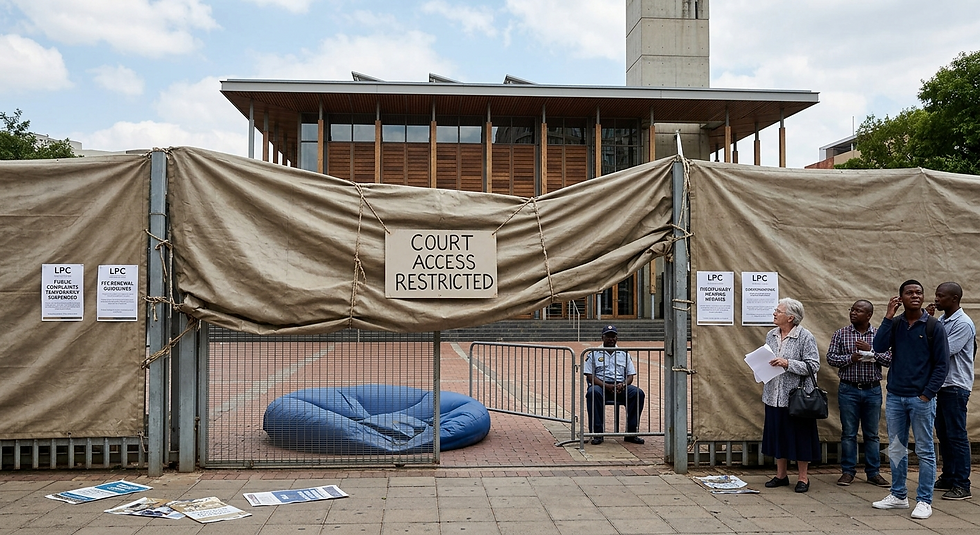
The physical reality at the Apex Court suggests a functional decay. The distinctive architecture on Constitution Hill, meant to embody transparency and democracy, like other courts, is frequently viewed from the pavement behind high fences and industrial coverings, creating a visible metaphor of the legal system as an exclusive citadel, effectively inaccessible to the public it serves. Maintenance is crucial for this heritage building, but the message covered fences send is a metaphor for what often happens away from the public eye. It’s not a good look.
When the highest court in the land is buckling under its own administrative inertia, relying on the judiciary as the final bulwark against the LPC’s inefficiencies starts to look like a desperate hope.
But this reality exposes a much larger, darker truth for ordinary South Africans. The entire legal pipeline is built to exclude them. If a citizen is scammed by a rogue attorney, their initial hurdle isn't the steep cost of a High Court application- it’s surviving an opaque litigation process so easily manipulated by predatory practitioners, so masterfully swept under the carpet by the LPC.
The Discipline Deficit: How Gatekeepers and Stalingrad Tactics Short-Circuit Legal Profession Discipline & Accountability
Professional discipline exists for reasons extending beyond punishment. It deters misconduct, reassures the public, reinforces professional norms, and provides confidence among practitioners whose reputations depend on effective regulation.
The structural rot at the pavement level of the legal profession doesn't, unfortunately, exist in a vacuum. It directly mirrors the high-stakes dysfunction playing out at the very apex of our justice system. When the LPC leaves tens of thousands of everyday consumer complaints to gather dust, it is merely mimicking a broader culture of deferral- a systemic reality where accountability is treated not as an immediate ethical mandate, but as a multi-decade negotiation.
This legal profession discipline deficit is driven by two distinct, highly effective structural shield mechanisms: the "Stalingrad marathon" and the "retirement loophole."
At the elite level, the playbook for dodging professional consequences relies on raw endurance, as demonstrated by multi-year litigation strategies that stall tribunals and hold regulatory bodies at bay. For the average South African, however, the battle for accountability grinds to a halt much earlier, long before reaching a High Court door.
The LPC's own data reveal a regulatory system that has effectively taught rogue practitioners that the rules do not apply to them. In its briefings to Parliament and public disclosures, the LPC admitted to handling an average of over 1,000 complaints every single month- exceeding 14,000 complaints, every single year.
Yet, when you look at the number of practitioners who actually face ultimate accountability- being suspended or permanently struck from the roll- the pipeline dries up almost completely.
Whether these structural concerns translate into measurable outcomes is ultimately an empirical question. Across a recent six-month stretch, the High Courts issued enforcement orders against just 50 legal practitioners nationwide in matters brought to their attention by the LPC:
Total Enforcement Cases: 50
Suspended from Practice: 30 (60%)
Struck Completely from the Roll: 20 (40%)
Type of Practitioner: 49 Attorneys, 1 Advocate
The concentration of these disciplinary actions is overwhelmingly centered around the country’s commercial hubs:
Province | Number of Practitioners Actioned | Percentage of Dataset |
Gauteng | 19 | 38% |
North West | 10 | 20% |
KwaZulu-Natal | 9 | 18% |
Western Cape | 3 | 6% |
Free State | 3 | 6% |
Eastern Cape | 3 | 6% |
Limpopo | 2 | 4% |
Mpumalanga | 1 | 2% |
Scaling this output results in an annual average of, at best, 150 successful terminal interventions out of 14,000 annual complaints. The LPC does fine, reprimand, or resolve minor disputes internally through its investigative committees without going to court, but the fines in the same period were minimal, consisting of mainly fines for lack of compliance with LPC administrative issues such as not filing annual reports.
While many complaints will inevitably prove unfounded or be resolved without formal sanction, the disparity between complaint volumes and terminal disciplinary outcomes remains difficult to ignore.
The systemic math is staggering. The ratio of ultimate accountability to incoming filings is an abysmal 1:93.3. Less than 1.07% of all complaints result in a practitioner being stripped of their credentials or suspended. Just 150 complaints a year make it through the complaints gauntlet. Being held to account for breaches of the rule of law- the LPA.
The rest of the pipeline consists of close to 14 thousand ordinary citizens, adrift in an inert system that takes years to investigate basic breaches, without success. Every year.
The Gauteng Mirage

While Gauteng appears to lead the charge on paper with 38% of national enforcement actions, no local LPC provincial disciplinary hearings were recorded during the same period. This sharp divergence between enforcement activity and visible disciplinary resolution raises immediate questions about how complaints are being processed within the provincial structure.
At intake levels of approximately 1,000 complaints per month nationally, the gap between reported volumes and observable disciplinary outcomes suggests that large portions of cases are resolved- or removed from the formal disciplinary track- at earlier administrative stages, whether through preliminary screening, evidentiary threshold assessments, or prolonged investigative timelines that result in complainant attrition.
It is difficult to sustain the assumption that a system receiving this volume of complaints is dealing predominantly with baseless claims. More plausibly, the data points to a structural breakdown in how complaints progress through the disciplinary pipeline. Whether this manifests as escalation to the High Court in select matters, or as stagnation within internal processes, the functional outcome is the same: the disciplinary mechanism ceases to operate as a reliable resolution channel.
By failing to resolve these matters internally through a functioning, completed inquiry process, the statutory regulator inevitably redirects its systemic pressure straight back onto an already overburdened bench. And complainants are faced with new delays in the court system.
And a regulator that functions well protects not only the public, but also the judiciary by preventing avoidable disciplinary matters from consuming scarce court resources.
The Fidelity Fund Bottleneck: Fox Guarding the Hens
The Legal Practice Council does not operate in isolation from the wider system of legal protection. Financially and structurally, it is interlocked with the Legal Practitioners Fidelity Fund and related indemnity mechanisms that determine not only how misconduct is punished- but how it is absorbed, delayed, and ultimately financed. Is the fox is set to guard the henhouse?
Proposed legislative changes regarding the Legal Practice Fidelity Fund Certificate (FFC) highlight this tension. An FFC is an absolute operational necessity for any sole practitioner or small firm in South Africa.
Under the proposed frameworks, the administrative process risks becoming a lethal bottleneck.
If an auditor delays a trust account submission by a single week, or if a firm trips over a minor administrative technicality under the Legal Practice Act, the LPC can instantly withhold or withdraw the FFC. Without an active certificate, a practitioner cannot legally hold public money. Operationally, the business is finished overnight.
While this strict administrative gatekeeping shifts the burden of filtering bad actors away from the LPC's slow disciplinary committees, it introduces a separate vulnerability. If a struggling practitioner chooses to operate underground without an FFC, the public loses the exact financial protection the fund was designed to guarantee, as the fund itself continues to amass significant reserves. Already, claims paid are a minimal compared with claims lodged. The bill delivers even less protection to the public.
The Public Cost of Impunity
It takes immense courage for an ordinary member of the public to lodge a complaint against a legal practitioner. Whistleblowing on a powerful, insulated industry is a daunting task, and even fellow practitioners hesitate to report colleagues without robust whistleblower protections. The public wants to believe in justice and play their part.
It simply cannot be true that 99% of LPC complaints are completely irrelevant or immaterial, yet less than 1.1% of practitioners are ever held accountable for bad conduct.
This failure illustrates not a lack of raw capacity, but a structural green light for lawlessness. When over 98% of complaints evaporate into the bureaucratic ether, practitioners increasingly operate with the comfortable knowledge that trust account deficits, unlawful contingency fee gouging, and outright abandonment of desperate clients carry almost zero institutional risk.
There's literally only a 2% chance that they will face consequences, and it will in any event take years, in which time anything can, and does happen. Complainants give up or give in. They fall ill, some even pass away. Even people who dare to seek justice without whistleblower protections aren't indestructible.
Where regulatory systems fail to act decisively, these functions weaken in practice, and public confidence erodes accordingly.
By treating everyday ethical policing as a secondary administrative chore, the statutory gatekeeper has effectively privatized impunity ... leaving 65 million citizens to navigate a gauntlet, in a world where believing in justice itself is becoming increasingly harder.
And every delay within the disciplinary process carries a hidden cost. Time is not a neutral administrative resource. For complainants, prolonged uncertainty often becomes part of the harm itself.
Balancing the Three Competing Objectives
Aside from studying and redesigning work processes- an exercise the LPC has embarked upon- the future of South African legal regulation depends on how the regulator balances three inherently competing priorities:
Objective | Primary Focus | Modern Tension |
Broadening access, increasing demographic representivity, and restructuring an exclusive historical legacy. | Ensuring that rapid structural adjustment does not compromise baseline professional standard entry points. | |
2. Public Interest | Protecting consumers of legal services, ensuring accountability, and preserving public trust. | Preventing administrative delays within the LPC from leaving the public exposed to rogue practitioners. |
3. Professional Independence | Preserving the independence of the bar and protecting lawyers from inappropriate external interference. | Avoiding a scenario where self-governance turns into institutional self-protection and low accountability. |
If the LPC cannot balance these mandates, the call for alternative regulatory models will grow louder. Dissolving the council completely may trigger immediate chaos, but leaving it unchanged guarantees a slow, silent dissolution of public trust. And an ongoing miscarriage of justice as systemic injustice prevails.
South Africans, for the most part, are seeking justice, wanting to uphold the law, and expecting the legal structures to support them in that quest. While the media remains abuzz with political corruption and institutional capture, the legal industry is fast moving into the wrong neighborhood. If you can’t beat them, you may as well join them is a mindset the actual legal system tasked with beating "them", which comes at a massive cost, can ill afford.
Clearly defining roles and resources to match the three mandated LPA-mandated goals will be key. But shifting away from pure self-governance toward truly independent, transparent oversight may be the only way to clear the backlog and restore public legitimacy before the institutional framework fractures entirely.
Because...

Every regulator is part of a wider justice ecosystem. Pressure isn't eliminated when one institution fails; it is merely displaced. What cannot be absorbed inside the regulator eventually arrives elsewhere- in the courts, in public confidence, in practitioner morale, and ultimately in the lived experience of those seeking justice.


Comments